Tuesday, August 20, 2019

Lost and Found


Late summer in London keeps me busy preparing for an art exhibition- yes, I know this is something of a departure once more, but it is not the first time ... before I emigrated to Mali and became the owner of a mud hotel I did work as an artist and had a couple of exhibitions in London. One of them was in Europe House, the head quarter of the European Commission in the UK. It was in December 2005, and it was the very first show of what became the 12 Star Gallery, a showcase of art by European artists. Because I did the first show, I am now honoured to have been invited to do, not quite the last, but most probably the penultimate show in this gallery which is now in its 19th year...!
( That I am hoping for some miracle to make the shows go on and,  most of all, to make the UK stay in Europe goes without saying...)

This is how it is described by the gallery:

Lost and Found
Works by Sophie Sarin

2-11 October 2019

Sophie Sarin was born in Sweden and has lived and worked in several European countries. Her work explores the subject of regeneration and rebuilding, celebrating the heroic and irrepressible human urge to construct and reconstruct order from chaos. She attempts to discover the extraordinary that resides in the ordinary and the accidental, and transforms the discarded and mundane into objects of interest and beauty, discovering meaning in the apparently meaningless. She often works with materials which would otherwise find their way to the recycling plant, performing her own form of recycling; a reassignment of purpose to humble, discarded items of everyday life.
Certain aspects of Sophie's work are also inspired by language and the wish to communicate across borders.

So, yes, I am running around looking for interesting bits to do something with- like the metal scraps from scaffolding planks above. I have found myself a studio in Hackney and have thrown myself head long into this new adventure- I only have six weeks! More about this soon...


In the middle of  this artistic flurry, I have also managed to see some friends- here is Cressida who came for Sunday lunch with a few others from her fabulous birthday party in Italy this summer. We had a wine flowing, jolly afternoon reminiscing, and I presented her finally with her birthday present, the necklace made from recycled flip flops I bought in Mopti a few weeks ago. She seems to like it, and it is perfect with her dress!


Tuesday, August 6, 2019

Being a Baobab


When I was in Bamako I met up with Mamane, one of the longest serving employees of Hotel Djenne Djenno. We met at the Sleeping Camel, here under the fresco depicting Thomas Sankara, the Che Guevara of West Africa, still a huge hero here.

Mamane has not been able to find any work- in Djenne there is nothing, and he is one of the many who has come to the capital to look for employment. I have asked if there is something for him here at the Camel, but there is no opportunity quite yet, so we have been looking at websites and I have been advising  him how to put a letter of application together.
At the end I decided to call Madou, the IT specialist from Djenne who is in Bamako at the moment. He is smart and knowledgeable and he will continue to help him, and Dembele too once he gets back to Djenne. When Mamane left, he said something to me, which I take to be a lovely compliment. He said: ‘You are still our Baobab!’

The Timbuktu trip was, as always, a complicated and intense time, since we only ever have one day in which to accomplish everything. This time that involved the formal end of the British Library’s two year project, and the beginning of Phase two. I did not know until a couple of days earlier that Father Columba, who came with me this time (with Dima Bondarev of the University of Hamburg), had decided to continue the project through his organization the HMML (Hill Museum and Manuscript Library, Minnesota), and I thought this trip may possibly be my last to my beloved Mali... 
But Columba  offered me to continue as project manager, only this time I work for them instead of the BL. I could not refuse, of course, and accepted happily  because  it will bring me back to Mali, and however much I complain about it, I still enjoy it hugely. Every time I go to Timbuktu it is an adventure, and for some reason the trips we do together always seem filled to the brim with extraordinary adventures. 
                                                                            
This time we were regaled by Boucar Tandina, the guardian at the Essayouti library who played for us at the end of our visit for the ELIT Project ‘family photograph’ which takes place every time I come.
The flight back was  unforgettable. 
As we boarded our little plane in Timbuktu a pretty young Kenyan girl who looked about fifteen said breezily: ‘I am your Co-pilot on today’s flight. There will be a little bit of turbulence , but nothing to worry about.’ ‘A little bit’ was certainly the understatement of the decade. After about half an hour we entered what I would like to describe as some sort of Biblical deluge with a hurricane thrown in for good measure and  the tiny  plane was thrown violently up and down, backwards and forwards, seemingly rudderless and abandoned to the elements like a ship wreck or a tiny snowflake in a snow storm. I held onto Father Columba and Dmitry and squeezed their hands in a relentless iron grip. 
Father Columba is the coolest and calmest person I know ( he was sending ‘thank you for dinner’ emails and working away quietly in Timbuktu while the machine gun fire was deafening all around our hotel during the attack on the UN head quarters in August 2017: see blog) but even he admitted to ‘feeling rather queasy’ during this ordeal...the picture below is of Jeremy Bristow when the storm had calmed down a little. Jeremy is a fun English documentary film maker who was with us this time, 
 Very glad to arrive at  Bamako airport.


Saturday, August 3, 2019

Made it!


Well, at least to the departure lounge at Mopti airport, where I am writing this on my way to that perpetually illusive Timbuktu. My plane- above, has landed so it is looking hopeful...

What is it that makes everyone insist, in the face of enormous obstacles, on reaching this fabled city, tucked away in a desolate place between the desert and the Niger river? Well, centuries past it was the rumour of the gold which was said to pave the streets of Timbuktu which drove explorers and adventurers to their deaths in great numbers, as they met their destiny at the hands of hostile tribesmen; succumbed to disease or died of thirst on their way. But their cruel fates only seemed to spur others on in their quest to reach this goal, excited by the lure of the seemingly unobtainable, like the ill-fated suitors of the cruel Princess Turandot.


Today the journey to Timbuktu continues to be fraught with seemingly insurmountable obstacles, but these for the rather less exotic reasons of bureaucratic mismanagement and sloppy customer service. I started two and a half months ago, just after my last trip had finished, to arrange this one for my three collegues and myself, and until this morning it was still unsure whether we had a place on the aircraft or not. 
                                                       
But here we are, once more on our way north- Father Columba, left above with Dima Bondarev and I, with the documentary film maker Jeremy Bristow, who will be filming us in the libraries.
The Niger snakes its way north, still narrow, but increasing in width daily. The earth is still the sandy colour of the Sahel north of Mopti: the rains have only just begun here and the  river vessel Modibo Keita which brought me to Timbuktu  last year has not yet begun its commuting between Mopti and Timbuktu. Some of the villages below us are winking at us, reflecting the sun from their few corrugated iron rooves, but most are entirely the colour of the surrounding earth from which they are built, with not a solar panel or a satellite disc in sight.


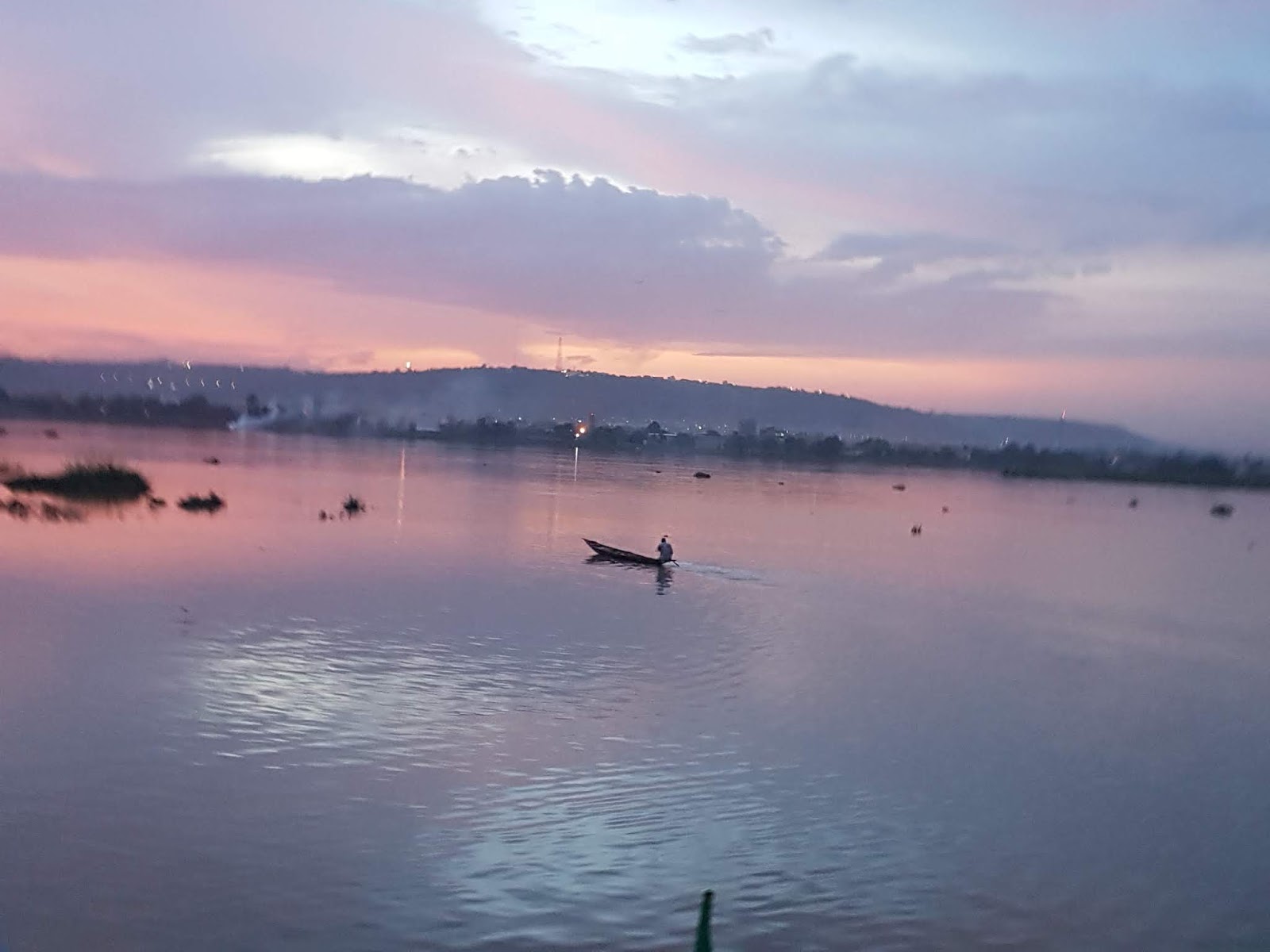
We reached Timbuktu and more of this tomorrow maybe, but now writing this is Bamako, which is beautiful in the rainy season sunset


Friday, July 26, 2019

In Mali

 I arrived in Bamako over a week ago, and have been busy working on final  accounts for the Timbuktu project and other necessary things. Nevertheless have seen dear Karen, (above) Hank, Phil, Matt, Paul and all other friends, since I stayed at the Sleeping Camel once more- for the last time before they move to a new location. Also had the time to go for a 'Hash', which is the weekly walking or running outing mainly for ex-pats in countryside surrounding Bamako.

But I sped northwards in Ga’s old Mercedes with its fake leopard skin fur draped over the dashboard yesterday, under heavy, rainladen clouds , through the familiar emerald of Mali’s July landscape. The village populations were out in force preparing their fields, the majority armed only with hoes, but some with donkeys or horses pulling small hand held ploughs which sliced through the black earth, moist and unctuous with yesterday’s rain.This road is so familiar to me. Once more I tried to figure out how many times I must have been up or down this major artery which links Bamako to the centre and the north. It must be over a hundred times. I know every turning. If I fall asleep and wake up, I can have a good guess at how long I have slept because of the small details the passing landscape reveals. There is what used to be the lovely painted facade of a building which advertises the local milk sold inside, only that now the painted cow has been sliced in half by an awkwardly placed corrugated iron roof on which a collection of discarded car tyres and old bicycles are forming; there is the sign advertising a ‘Foret Classifie’ which is supposed to be a protected natural forest, only there are virtually no trees there...; The crossing of the Bani happens about twenty minutes after Segou on the northward journey. The recent rains have brought torrents of mud down the Bani which now flows white/ochre like vanilla  ice cream , swelling with every new rain, towards its destiny at Mopti where it surrenders itself up to the Niger.


The proximity to San is announcd by the first horses- central Mali  is horse country.
 The ‘Entrance Gate’informing travellers of the arrival in the Mopti region has a turning immediately to the left where it is possible to take a short cut to Djenne along the village dirt road to Madiama, but in the rainy season that is an uncertain proposition and we decided to go via the Djenne Carrefour where the Gendarmes’ guard post is now heavily fortified with cement-filled oil drums all around. Any hapless traveller who arrive here after sunset is forced to stay the night, because of the kerfew which has been enforced for about a year here. That has made a new local enterprise spring up: it is possible to hire a ‘natte’ a plastic mat on which to sleep for those who find themself in this unfortunate predicament.

We reached Sanouna by Djenne to cross once more the Bani towards the end of the day when the shadows had lengthened. I took off my shoes. The water felt warm but refreshing as I waded across the soft sand to the platform which had been lowered for the vehicles to board the ‘Bac’, or the small car ferry which carries all vehicles and other traffic to and from Djenne. Ga drove the Merc on to the Bac with a great roar, splashing the water either side.  I remembered when I arrived in Djenne to start my new adventure in April 2006. It was the Great Heat and the water stood lower that ever: it just reached our calves and we were able to cross the river on foot. That never happened again.

Now there is no ‘home’ for me in Djenne I am obliged to stay at the Campement, which I found deserted apart from dear Brin, the faithful Man Friday of this old hotel, whose son is called Oumar – or Barou like all Oumars- in honour of my Oumar Keita, his great friend. Brin greeted me with a chivalrous flourish like he always does, by kissing my hand and saying ‘La Princesse!’.
There was just enough time to sit happily in the courtyard with some peanuts and whisky and water before Brin announced the rather devastating news that there was no electricity in Djenne. That meant that what is a just about bearable experience: to sleep on a bad mattress with bad sheets and and the hard pillows found in most African hotels would turn into a memorably awful night- all of the above, but without a fan or AC or even a light in the hot and humid African night, the air buzzing and alive with the enormous insects that hover around when the sun sets in the rainy season... and coupled with that, the fact that my telephone and computer were completely without ‘juice’, and were not going to be recharged! Happily we are made in such a way that the memories of the hardships of a dreadful night normally melt away in the sunshine of the following morning.  

This time Djenne seems to smile on me. I recognize just about every adult I cross on my way through the rain sodden, muddy streets and I greet everyone just to be on the safe side, even if I can’t quite place them, because they all seem to know me. ‘Sophie! I ni Fama! Somogow?’ (‘Sophie, Its been a long time! How is the family?’)And I stop and chat a little and pretend I know who they are. I suppose it is easier for them to remember me, the only toubab around amongst 13000 Malian for the 12 years I lived here... at least that is what I use as an excuse. 

                                                                              
I went to see Imam Yelpha as always (arriving at his Koran school above). I have to put on a scarf these days to visit him and I am not allowed to shake his hand in public- these measures to show respect for his position. But once we are sitting on the sand floor inside his Koran school he is as friendly as ever. ‘My heart jumps a little when I see you’ said lovely Yelpha, and I reflected how nice it would be if  people said things like that to each other in Europe...

Tomorrow I will go to the library to have a meeting regarding the new foundation we are setting up, the ‘Friends of the Djenne Manuscripts’, and then onwards and northwards!
 Let’s hope the electricity  which finally came on will continue during this  night...


Saturday, July 6, 2019

IL PALIO!


It has become necessary to join another great spectacle to my others, carefully collected during my life when I have been fortunate  to see many fabulous things which I call my wonders of the world. It is not easy to be included in this list, which consisted of only 3 before: the Goroka Show in the highlands of Papua New Guinea; ‘J'Ouvais' at the opening of the carnival in Port of Spain, Trinidad ; the ‘crepissage’ of the Great Mosque of Djenne ( of course!) But these three have now had to admit one more in their glorious midst: The PALIO in Siena: the great bare back horse race around the Piazza del Campo.


And, come to think of it, even the city of Siena must   join my own private pantheon of the most wonderful cities of the world, which now include Stockholm, New Orleans, Djenne, Lyon and Siena. There are many similarities between Sienna and Djenne, surprisingly. For a start, Siena is the oldest city in Tuscany, settled by the Etruscans many centuries B.C., and Djenne is the oldest city not only in Mali but in West Africa , first settled over 250 BC.
In the first part of the 14th century Siena built their magnificent Duomo, while at the same time the Djennenke built the first version of their great Mosque. Both cities saw the pinnacle of their importance around the 14-16th centuries after which their power waned.
 Another striking similarity is the importance and friendly competition between the neighbourhoods in the great yearly event of the two cities: in Djenne the eleven ‘kin's compete to win the prize at the crepissage, and in Siena the 17 ‘Contrade’ put up a fierce battle to win the Palio.
There is more:  the beautiful slender horses used and bred specifically for the Palio are called ‘Barberi' from ‘Berber’ because the race originates in Africa, in this case North Africa, but these are undoubtedly from the same race as the  fine limbed Malian horses, which are of the ancient race  that made up Sundiatta' cavallery when he unified the tribes and founded the Malian empire in the 13th century.

When I see these horses I think of my lovely Maobi, Napoleon and Petit Bandit that I was fortunate enough to have owned and ridden across the dusty plains of the Macina by Djenne...

 It is an unforgettable experience to witness the Contrade parading through the streets of Siena in their colourful costumes to the sound of the drums, performing intricate manoeuvres with the flags which are carrying the insignia of their Contrada.


Before they arrive in the Piazza del Campo they all file past the Duomo and wave to what I believe must be the cardinal, who waves back and makes the sign of the cross over them all.

Blessings are very much the order of the day and on the morning of the Palio the jockeys all receive a blessing in the Piazza del Campo before the horses are also blessed, by the altar inside the churches of each Contrada!


A great procession around the Piazza precedes the actual race, and finally, after four days of intense build-up the race finally explodes in a wild burst of just over a minute: this time the GIRAFFA Contrada beat the favourite Chiocciola Contrada(the centipede) by a few centimetres in a hair raising finale before the roaring crowd of many thousands.

. Then followed the traditional celebrations which have not yet come to an end...
first to the church of Santa Maria in Provenzano,

to thank the Virgin, carrying the coveted standard of the Palio, while the victorious horse Tale e Quale got a well deserved shower and feed, then the party continued all night and the next day...

Wednesday, June 26, 2019

In Italia

In beautiful Siena under a cloudless sky, writing this with my big thumb on my phone since I left my computer in a little beautiful hilltop village called Petritoli in la Marche, but more about that later...
My arrival in Siena last Sunday could not have been more spectacular: even as I entered the little flat I am sharing with a fellow student from my language school towards evening, the street under my window was alive with the sound of drums and the colours of the ‘contrada’ (neighbourhood) ONDA, out in force flying their flags and resplendent in their medieval costumes in the first rehearsal for the PALIO, the great festival which begins on Saturday and culminates next Tuesday with the horse race around the Piazza del Campo, the great shell shaped central ‘square’ in Siena, built in the beginning of the fourteenth century at the height of Siena’s importance when the city was bigger than both London and Paris with 60000 inhabitants. Only a few years later Siena was decimated by the black death which wiped out two thirds of the population. But first they had time to build up the most perfect of cities which is more or less untouched within the city walls.
History feels very close here. Therefore the young men don't look like they are on their way to a pantomime when they march through the cobbled streets but the sight of them, and the sounds of their drums and their singing is powerful and the surprise of it all made me both cry and laugh with the joy of a child at Christmas. I deposited my travelling bag and followed in their wake as they gained more and more members and marched into the great Piazza del Campo. What a welcome to Siena!

This spectacular entry followed in quick succession after two other memorable eventsand : the train journey that brought me through France deposited me in the great city of Lyon for one more lovely encounter with my dear friends Pascal and Monique who visited Hotel Djenne Djenno a long time ago in happier times in Mali, and whom I visited some years ago when they taught me to love their great city with its ‘traboules',’pot’s and ‘bouchons'. Once more we had a splendid evening and once more I am convinced that Lyon is where the best food in the world is undoubtedly found...
The following morning the train sped me on to Italy towards the Adriatic coast and the little town of Petritoli for the 60th birthday party of my dear friend Cressida in a little Palazzo that she had hired where the party was already in full swing when I arrived.Three lovely days followed ....( I realize this is beginning to sound like an article in Hello magazine, but can't help it.. it has been rather wonderful and glamorous and here are some pictures from all this jolliness.

Please forgive me if it doesn’t come out perfectly...as I said I am writing with my thumbs and trying to work with my phone and not used to that. And now I will take a walk around this lovely town in the heatwave of this Italian summer, sit down at a trattoria for an aperitivo and do some Italian revision... ciao!